
Tag: comet

  • Spectacular Comet C/2026 A1 (MAPS) Observing Guide

    Spectacular Comet C/2026 A1 (MAPS) Observing Guide

    “They are calling it a sungrazer—a comet that passes very near to the Sun and if it survives, may be visible in broad daylight. So, what is the likelihood of Comet C/2026 A1 (MAPS) actually becoming a daylight comet?

    More about Discovery

    ☄️ Comet Profile: C/2026 A1 (MAPS)

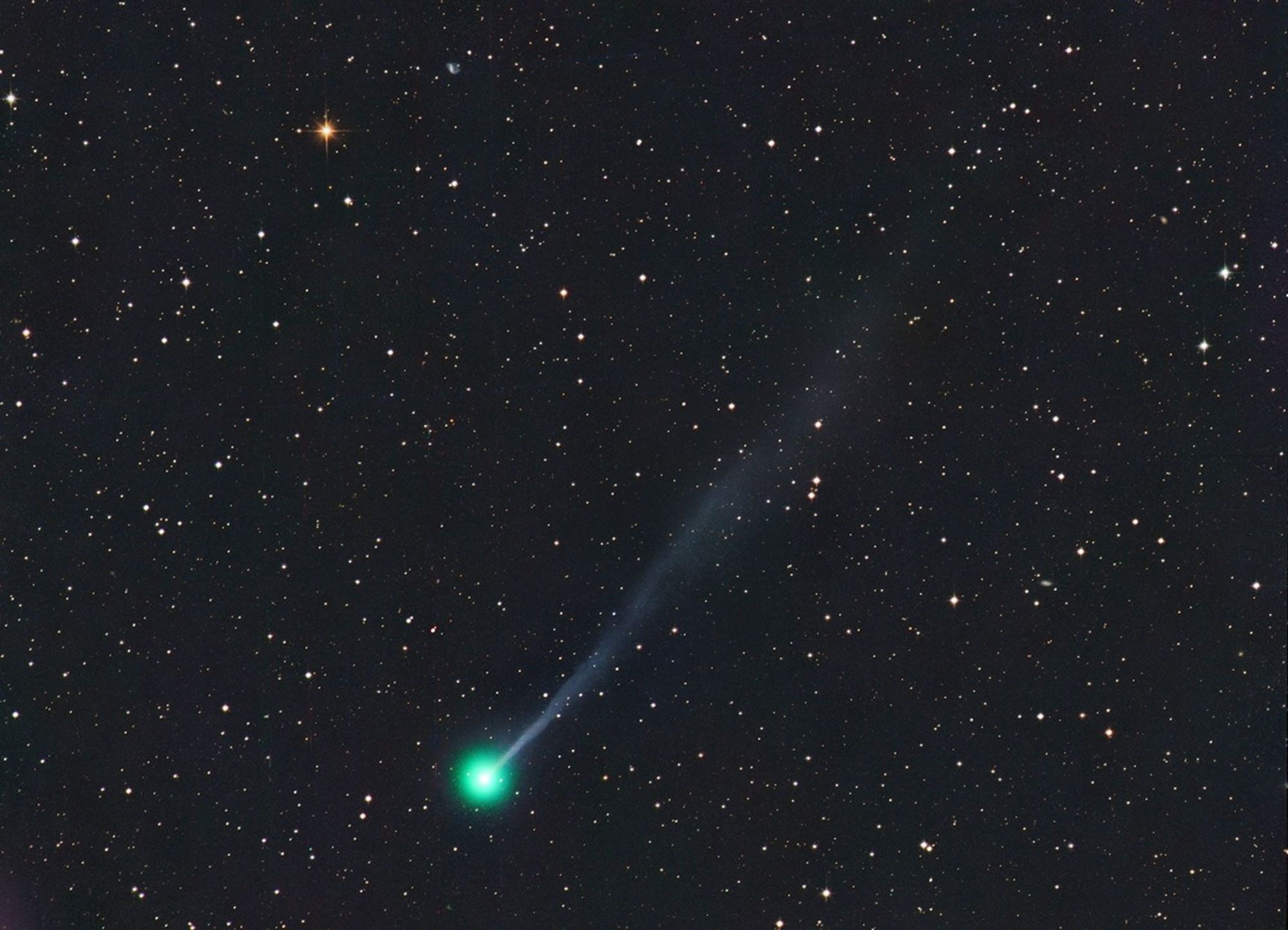
    Comet C/2026 A1 MAPS

    Credit: Michael Jäger & Gerald Rhemann
    Source: NASA

    Full Name
    C/2026 A1 (MAPS)
    Discoverer
    MAPS (Mauna Kea) Survey
    Comet Type
    Near-Parabolic
    Discovered
    January 2026
    Closest to Sun
    April 04, 2026
    Closest to Earth
    April 05, 2026
    Current Mag
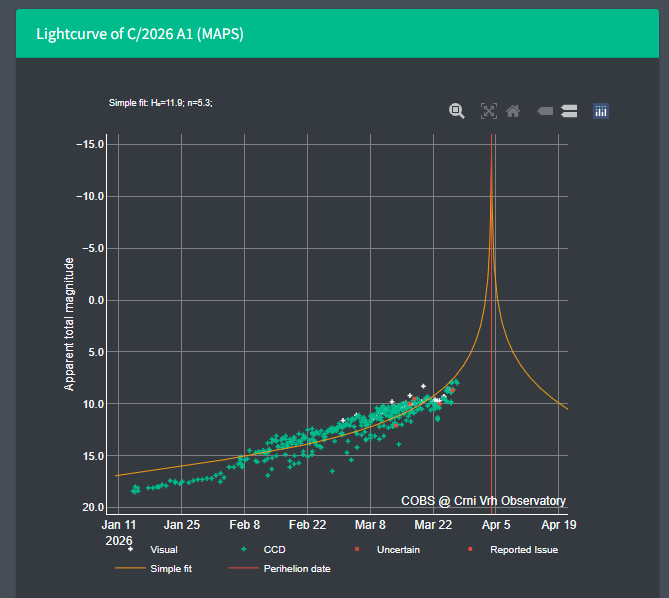
    ~7.4 (Brightening) Check Live Brightness ↗

    *Reference: Latest observation data via COBS Database (Object 2688).

    KOSMIKAI Observation Terminal

    Target: C/2026 A1 (MAPS)

    HELIOCENTRIC PERSPECTIVE

    NASA Orbit Planner

    View from the Sun’s Center. Tracks the 3D trajectory and the “hairpin turn” around the solar core.

    OPEN JPL ORBIT VIEW 🛰️
    OBJECT ID C/2026 A1 (MAPS)
    ENGINE NASA JPL
    TOPOCENTRIC PERSPECTIVE

    Live Sky Tracker

    View from Your Location. Essential for actual observation, altitude, and azimuth positioning.

    OPEN SKY-MAP 🔭
    OBJECT ID C/2026 A1 (MAPS)
    ENGINE THE SKY LIVE

    COMET DATA

    C/2026 A1 (MAPS)
    PREDICTED (NASA)
    model prediction (not observed)
    OBSERVED (LATEST)
    7.0
    🔵 NASA/JPL 🟡 COBS

    Comet C/2026 A1 (MAPS) – Luminosity Trend

    READY
    INITIATING NASA DATA LINK…
    Source: NASA/JPL SSD (↑) Higher = Brighter

    Observer's Verdict & Forecast

    RATING ★★★★★
    BEST VIEW IN Southern Hemisphere (Primary), with good location can be visible from the Northern Hemisphere
    VIEWING REQ. Binoculars / Unaided Eyes
    CAPTURING REQ. Tripod + Long Exposure
    UNAIDED EYE? YES (From April 1) Expected
    VISIBLE IN INDIA YES (Challenging / Low Horizon)
    Best Viewing Window:
    March 28- April 02 & after April 04 (if survives) (after sunset 19:15 - 20:30 IST)
    Moon Condition:
    Full Moon on April 2. Sky contrast improves significantly after April 5. (Check Moon Phases)
    Prediction by BoltiPhoto: "Good to observe, but most probably it will disintegrate. Moonlight is also interfering with it before perihelion. If it survives after perihelion, it will give a show to us. Remember, comets are very unpredictable and amazing if they survive the extreme close pass of the sun."
    Sky Navigation Guide

    DATE: LOADING...
    Nainital Horizon View
    ARIES CETUS
    VENUS
    C/2026 A1 (MAPS)
    SW (225°) WSW (247°) WEST (270°) WNW (292°)
    Real-Time Altitude
    12.0°
    Observation Window
    Standby
    NOTE: Conceptual model for general idea. For exact live coordinates, see:
    Stellarium Web | The Sky Live

    Sky Navigation Guide

    INITIATIVE: KOSMIKAI | NAINITAL, UK
    DATE: --/--/----
    Primary Direction
    W-SW
    West-Southwest
    ALTITUDE 5° — 12° (Very Low)
    CONSTELLATION Cetus / Pisces
    TIME WINDOW Sunset + 45 Mins
    🔭 General Observing Tip: To spot the comet, prioritise a location with a perfectly clear, flat West horizon. Go to a peak if you can. Use "Averted Vision" to help your eyes detect the faint glow of the tail against the twilight sky.
    📸 Capturing the Comet (Bolti Photo Advice):
    Smartphone: Use 'Night Mode'/Manual on a tripod. Set focus to infinity and exposure to 3-5 seconds. Tough but possible.
    DSLR/Mirrorless: Start with Wide-angle lens (max aperature). Shutter speed: 10s if at 18mm on APSC ISO 800-1600, can decrease if the image is overexposed. Focus Manual and at Infinity. If you spot the comet, put it at the centre of the frame, then zoom it to take more photos.
    K O S M I K A I

  • Dual Comets in April 2026: A Rare Celestial Double Feature

    Dual Comets in April 2026: A Rare Celestial Double Feature

    🚀 Live Update: March 28, 2026

    C/2025 R3 (PanSTARRS) has maintained its trajectory and is now visible through binoculars in the pre-dawn sky. C/2026 A1 (MAPS) is showing signs of significant outgassing—stay tuned for daylight visibility confirmations!

    Two Comets for April 2026

    April 2026 is shaping up to be the month of the comets. Two distinct icy visitors are racing toward the Sun, potentially offering a rare opportunity to witness these “dirty snowballs” with the naked eye. If orbital survival and brightness predictions hold, we are in for a historic show.

    1. The Daylight Contender: Comet C/2026 A1 (MAPS)

    Details of Comet C/2026 A1 (MAPS)

    First highlighted in our Yearly Astronomical Events guide, C/2026 A1 (MAPS) is the one to watch.

    • Peak Visibility: Around April 4th, 2026.
    • The “Survival” Factor: Its visibility depends entirely on whether the nucleus survives its intense perihelion (closest approach to the Sun).
    • Potential Brightness: Some models (COBS) suggest it could reach a staggering -15 magnitude. If this occurs, the comet would be visible in broad daylight, outshining the full moon.
    • Best Viewing: Primarily the Southern Hemisphere, though Northern observers may catch a glimpse low on the horizon.

    2. The Northern Favorite: C/2025 R3 (PanSTARRS)

    While not as potentially explosive as MAPS, C/2025 R3 (PanSTARRS) is a much more reliable target for those in the Northern Hemisphere.

    Details about Comet C/2025 R3 PanSTARRS

    • Peak Visibility: Late April 2026.
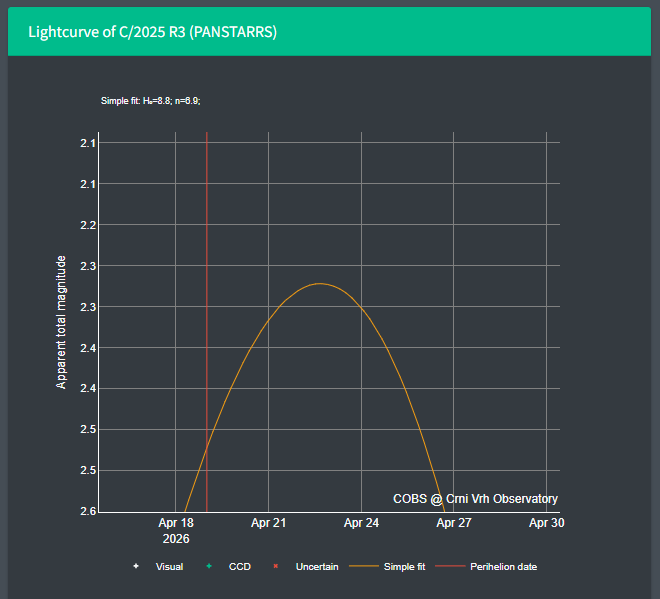
    • Perihelion Date: April 19, 2026.
    • Current Status: As of late March, it sits at a steady +7.0 magnitude.
    • Expected Brightness: It is projected to peak at +2.3 magnitude, making it a clear, easy target for the naked eye in dark skies and a stunning subject for astrophotographers.

    Gear Up and Get Ready

    Whether you are a seasoned astrophotographer or a casual stargazer, April offers a unique window to capture these ancient travelers. Dust off your tripods and find a location with low light pollution.

    Stay tuned to this post! We will provide real-time coordinate updates and survival news as these comets approach the Sun.


    अप्रैल 2026 के दो धूमकेतु

    2026 अप्रैल में दिखेंगे दो अनोखे धूमकेतु: बिना किसी उपकरण के देखने का सुनहरा मौका

    अप्रैल 2026 खगोल प्रेमियों के लिए बेहद खास होने वाला है। इस महीने दो धूमकेतु (Comets) सूर्य की ओर बढ़ रहे हैं, जिन्हें हम बिना किसी दूरबीन या विशेष गियर के अपनी आंखों से देख सकेंगे।

    1. धूमकेतु C/2026 A1 (MAPS): क्या यह दिन में भी दिखेगा?

    जैसा कि हमारे ‘वार्षिक खगोलीय घटनाओं’ के लेख में बताया गया था, C/2026 A1 (MAPS) इस महीने का सबसे बड़ा आकर्षण है।

    • कब दिखेगा: 4 अप्रैल 2026 के आसपास।
    • विशेषता: यदि यह सूर्य के सबसे करीब (Perihelion) पहुंचकर सुरक्षित रहता है, तो इसकी चमक -15 मैग्नीट्यूड तक जा सकती है। अगर ऐसा हुआ, तो यह दिन के उजाले में भी दिखाई देगा!
    • कहाँ से देखें: यह मुख्य रूप से दक्षिणी गोलार्ध (Southern Hemisphere) में साफ दिखेगा, लेकिन उत्तरी गोलार्ध के लोग भी इसकी एक झलक पा सकते हैं।

    2. धूमकेतु C/2025 R3 (PanSTARRS)

    उत्तरी गोलार्ध (भारत जैसे देशों) के लोगों के लिए C/2025 R3 (PanSTARRS) सबसे बेहतरीन मौका है।

    • सबसे अच्छा समय: अप्रैल के अंत में।
    • चमक: वर्तमान में इसकी चमक +7.0 है, लेकिन 19 अप्रैल 2026 तक यह +2.3 मैग्नीट्यूड तक पहुँच सकता है, जिससे यह नग्न आंखों से आसानी से दिखाई देगा।

    तैयार हो जाइए! चाहे आप एक अनुभवी एस्ट्रो-फोटोग्राफर हों या बस आसमान निहारने के शौकीन, अप्रैल का यह महीना इन प्राचीन अंतरिक्ष यात्रियों को कैमरे में कैद करने का एक अनोखा अवसर दे रहा है। अपने ट्राइपॉड तैयार रखें और ऐसी जगह चुनें जहाँ शहर की रोशनी का प्रदूषण (Light Pollution) कम हो।

    इस पोस्ट से जुड़े रहें! जैसे-जैसे ये धूमकेतु सूर्य के करीब पहुँचेंगे, हम आपको इनके सटीक निर्देशांक (Coordinates) और इनके बचने की ताज़ा खबरें (Survival Updates) यहाँ देते रहेंगे।